Inroduction
Every important decision contains some uncertainty.
Choosing a career, launching a project, evaluating an opportunity, allocating resources, planning for a changing market, or deciding whether to wait for more information all require action before the future becomes completely clear.
That creates a deceptively difficult question:
How do you make a good decision when you cannot know what will happen?
The science of decision-making under uncertainty brings together decision theory, probability, economics, statistics, psychology, behavioral science, forecasting, and risk analysis. Its purpose is not to produce magical certainty. It is to help people make choices that remain sensible when information is incomplete, and the future can surprise them.
The foundational distinction is important: a good decision is not necessarily the same thing as a good outcome. A thoughtful decision can produce a disappointing result because of an unpredictable event, while a poorly reasoned choice can occasionally succeed through luck.
Below are original quote-style insights designed to make the core principles memorable and shareable.
The Best Quotes About Decision Making Under Uncertainty
Decision making becomes easier to understand when complicated ideas are reduced to memorable principles. These lines capture the central philosophy of making choices without pretending the future is predictable.
- “A decision can be intelligent even when the outcome is unexpected.”
- “Uncertainty does not stop decisions; it makes decision quality matter.”
- “The future does not need to be predictable for a choice to be thoughtful.”
- “Good decisions begin where false certainty ends.”
- “A forecast is a possibility, not a promise.”
- “The smartest decision is often the one that survives being wrong.”
- “You cannot control uncertainty, but you can control how you respond to it.”
- “Better decisions come from better questions, not louder confidence.”
- “Knowing what you do not know is part of knowing what to do.”
- “A strong decision process makes room for surprises.”
- “Uncertainty is not an excuse for indecision.”
- “The goal is not perfect prediction; it is intelligent preparation.”
- “Every assumption is a door through which uncertainty can enter.”
- “A decision becomes stronger when its weaknesses are visible.”
- “When certainty disappears, disciplined thinking becomes your advantage.”
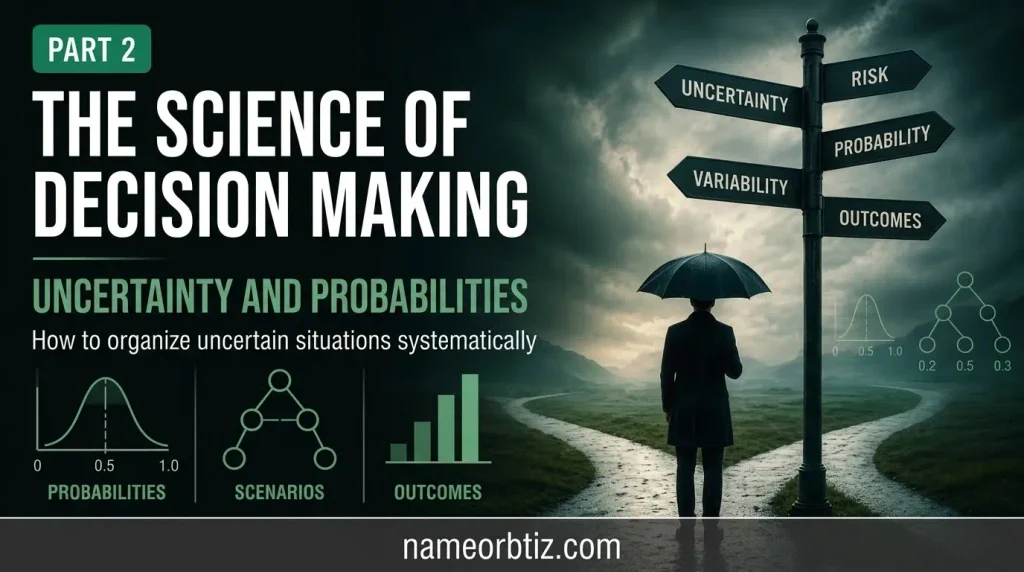
The central concept is straightforward: decision-making under uncertainty means choosing an action when future outcomes cannot be known with complete confidence. A decision normally involves available choices, possible states of the world, and the consequences associated with each combination.
Short One-Liners About Risk and Uncertainty
Risk and uncertainty are often treated as synonyms, but decision science distinguishes them. Under risk, probabilities can often be estimated. Under uncertainty, the probabilities themselves may be poorly known. Ambiguity goes further when multiple reasonable probability models compete.
- “Risk has numbers; uncertainty has questions.”
- “Probability measures belief; it does not guarantee reality.”
- “Unknown odds are different from known odds.”
- “Risk can often be modeled; uncertainty must often be explored.”
- “Ambiguity begins when reasonable models disagree.”
- “A percentage is not a promise.”
- “Uncertainty grows when assumptions multiply.”
- “Risk asks how likely; uncertainty asks how much we really know.”
- “The unknown is not always measurable.”
- “A precise number can still hide an uncertain assumption.”
- “Good analysis starts by naming the kind of uncertainty involved.”
- “Not every unknown deserves the same response.”
- “When probabilities are weak, robustness becomes more valuable.”
- “The quality of a probability depends on the evidence behind it.”
- “Confusing uncertainty with certainty is itself a decision risk.”
Expected Utility Quotes for Smarter Choices
Expected utility is one of the classical foundations of decision theory. In simplified form, it compares possible outcomes by considering their probabilities and utilities rather than looking only at the largest possible payoff.
- “The biggest payoff is not always the best choice.”
- “Probability tells you how likely; utility tells you how much it matters.”
- “Expected value compares futures without pretending one is guaranteed.”
- “Averages help compare uncertainty; they do not erase it.”
- “Two people can value the same outcome differently.”
- “Money is measurable; usefulness is personal.”
- “The best option depends on both outcomes and preferences.”
- “Expected utility turns uncertain possibilities into comparable choices.”
- “A weighted average is a decision tool, not a prophecy.”
- “Good decisions consider what outcomes mean, not merely what they cost.”
- “The rational choice depends on the decision maker’s objectives.”
- “A high expected payoff can still be unacceptable to a risk-averse person.”
- “Utility connects mathematics with human priorities.”
- “Expected utility gives uncertainty a structure.”
- “Models simplify choices; judgment decides whether the simplification is useful.”
Bayesian Decision-Making Quotes
Bayesian reasoning emphasizes updating beliefs when meaningful evidence arrives. Instead of defending an old forecast simply because it was once believed, the decision maker changes the assessment as new information appears.
- “New evidence deserves a new belief.”
- “Changing your mind can be evidence of good thinking.”
- “A forecast should evolve when the facts evolve.”
- “Beliefs are tools, not permanent contracts.”
- “Evidence is valuable when it changes what you do.”
- “Yesterday’s probability is not automatically today’s probability.”
- “Smart thinkers update without surrendering their principles.”
- “A strong belief should have a path for revision.”
- “New information is useless if your conclusion cannot change.”
- “Bayesian thinking treats learning as part of deciding.”
- “The question is not whether you were wrong before; it is whether you learn now.”
- “Good reasoning has an update button.”
- “Evidence should move beliefs in proportion to its strength.”
- “Refusing to update is not consistency; sometimes it is stubbornness.”
- “A flexible forecast is often stronger than a confident forecast.”
Cognitive Bias Quotes for Better Judgment
Uncertainty gives cognitive biases plenty of room to influence judgment. Overconfidence, confirmation bias, availability bias, anchoring, loss aversion, and sunk-cost thinking can all distort how people interpret uncertain choices.
- “Confidence is not evidence.”
- “The mind loves a conclusion before it loves a correction.”
- “What feels familiar can look more probable than it is.”
- “An early number can become an unnecessary anchor.”
- “A past investment is not a reason to repeat a future mistake.”
- “Being certain does not make being correct more likely.”
- “Confirmation feels comfortable because contradiction requires work.”
- “Memorable events can distort ordinary probabilities.”
- “Losses often feel louder than equal gains.”
- “Your first estimate is information, not destiny.”
- “A bias becomes dangerous when it feels like common sense.”
- “Good decision makers challenge their favorite explanation.”
- “The brain seeks shortcuts; uncertainty sometimes requires a longer route.”
- “Ask what evidence would prove you wrong.”
- “The best bias check is often an uncomfortable question.”
Probability Quotes About Thinking in Chances
Probability makes uncertainty explicit. It encourages decision makers to move beyond vague phrases such as “this will probably work” and ask what evidence supports the estimate and how sensitive the decision is if the estimate is wrong.
- “Probability expresses likelihood, not destiny.”
- “A 70% chance still leaves room for the 30%.”
- “Good probabilities need good evidence.”
- “False precision is uncertainty wearing a suit.”
- “A number without assumptions can create fake confidence.”
- “Probability should clarify uncertainty, not hide it.”
- “Ask where the estimate came from.”
- “Historical data can inform a probability without guaranteeing the future.”
- “Expert judgment is useful when its limits are visible.”
- “A model is only as useful as the assumptions behind it.”
- “Chance belongs in the conversation whenever certainty does not.”
- “Probability helps compare possibilities without pretending to know outcomes.”
- “A forecast becomes stronger when its uncertainty is stated.”
- “Do not confuse a likely event with a certain event.”
- “Think in ranges when a single number creates false confidence.”
Quotes About Knowing When to Gather More Information
More information is not automatically better. Value-of-information analysis asks whether additional evidence could actually improve the decision enough to justify its cost in time, money, effort, delay, or opportunity. Research also emphasizes identifying which uncertainties are genuinely decision-critical.
- “More information is useful only when it can improve the choice.”
- “Research has a cost even when the research itself is free.”
- “Do not investigate what cannot change your decision.”
- “The best question is not ‘What else can I learn?’ but ‘What could learning change?’”
- “Information has value when it moves action.”
- “Waiting for perfect information can become its own mistake.”
- “A useful fact can influence a useful decision.”
- “Not every unknown deserves another study.”
- “Ask what information would actually change your mind.”
- “The value of research depends on the decision it can improve.”
- “Data collection should have a purpose.”
- “More evidence is not the same as better evidence.”
- “Information can reduce uncertainty without eliminating it.”
- “The smartest research question has a decision attached to it.”
- “Sometimes the best information is knowing you already have enough.”
Scenario Analysis Quotes for Multiple Futures
Scenario analysis replaces the temptation to treat one forecast as “the future” with several plausible ways events might unfold. The uploaded source recommends favorable, central, adverse, and disruptive scenarios as a practical way to test decisions.
- “One forecast is a story; several scenarios are a strategy.”
- “Do not ask only what happens next; ask what could happen next.”
- “A strong plan has more than one future in mind.”
- “Scenario planning prepares you for surprises before they arrive.”
- “The future is rarely obligated to follow your spreadsheet.”
- “Hope is not a scenario.”
- “A bad scenario is useful when it reveals a weak decision.”
- “Planning for multiple futures creates flexibility.”
- “The purpose of scenarios is preparation, not fortune-telling.”
- “A resilient plan can survive an unexpected chapter.”
- “Test the decision against futures you would rather ignore.”
- “The uncomfortable scenario may contain the most valuable lesson.”
- “One forecast can fail; a portfolio of scenarios can teach.”
- “Scenario analysis turns uncertainty into something you can examine.”
- “Prepare for several plausible worlds, not one Imaginary certainty.”
Sensitivity Analysis Quotes About What Really Matters
Sensitivity analysis asks how much a decision changes when assumptions change. It helps analysts identify the variables that genuinely drive the recommendation instead of wasting effort measuring factors that have little influence.
- “Not every assumption deserves equal attention.”
- “Find the variable that can change the decision.”
- “Sensitivity reveals where uncertainty has teeth.”
- “If a tiny assumption change reverses the answer, pay attention.”
- “Measure what matters, not merely what is measurable.”
- “A model can contain many variables but only a few decision drivers.”
- “The strongest analysis knows which assumptions are fragile.”
- “Spend research effort where the decision is sensitive.”
- “A stable decision needs less fear around minor variables.”
- “A fragile conclusion deserves a closer look.”
- “Sensitivity analysis asks which uncertainty actually matters.”
- “The loudest variable is not always the most important.”
- “Small changes can expose large weaknesses.”
- “A decision is stronger when its critical assumptions are visible.”
- “If changing one input changes everything, that input deserves attention.”
Robust Decision-Making Quotes
Robust decision making becomes especially useful when probabilities are unreliable or difficult to specify. Instead of selecting only the option with the highest expected payoff, a robust strategy may seek acceptable performance across many plausible futures.
- “A robust decision does not need a perfect forecast.”
- “The best plan may be the one that survives several futures.”
- “Robustness values acceptable performance when certainty is unavailable.”
- “A fragile victory is not always better than a reliable result.”
- “Build plans that can bend without breaking.”
- “When probabilities are weak, resilience becomes evidence.”
- “The future can punish plans built around one assumption.”
- “Robust choices leave room for adaptation.”
- “A good strategy should have somewhere to go when the forecast fails.”
- “Preparation beats precision when precision is unreliable.”
- “Robustness asks whether the decision remains useful after assumptions change.”
- “A plan that works only in one future is a bet on that future.”
- “Good decisions protect against more than one kind of surprise.”
- “The strongest option is sometimes the least fragile.”
- “When you cannot predict the future, design for flexibility.”

Minimax Regret Quotes About Avoiding Major Mistakes
Minimax regret focuses on how badly a choice could compare with the best decision that could have been made after the actual future became known. It provides a different perspective from simply maximizing expected value.
- “Sometimes the question is not ‘What wins?’ but ‘What hurts least if I am wrong?’”
- “Regret asks what the future might make you wish you had chosen.”
- “The biggest opportunity is not always worth the biggest downside.”
- “A decision can be judged by the mistake it prevents.”
- “Think about the cost of being dramatically wrong.”
- “Minimax regret puts future hindsight into today’s analysis.”
- “The safest choice is not always the best; the smartest protection is context-dependent.”
- “Ask which mistake you can live with.”
- “A decision becomes clearer when its worst regret is visible.”
- “Upside matters, but so does the price of missing the better path.”
- “Regret analysis turns hindsight into a planning tool.”
- “The future cannot tell you the answer today, but it can reveal which mistakes matter most.”
- “Compare choices by what you could lose by choosing them.”
- “A good decision considers both opportunity and regret.”
- “Sometimes resilience means limiting the size of your future disappointment.”
Quotes About Decision Quality Versus Outcome Quality
A critical lesson in decision science is that a good process can produce a poor outcome because of luck, while a poor process can occasionally produce a good outcome. Judging decisions only by their results can therefore encourage harmful hindsight bias.
- “A bad outcome does not automatically prove a bad decision.”
- “Luck can reward poor reasoning.”
- “A good process deserves evaluation before the result.”
- “Judge the decision with the information available at decision time.”
- “Hindsight knows more than the decision maker did.”
- “Outcome and decision quality are related, but they are not identical.”
- “A successful result can hide a weak process.”
- “A disappointing result can come from a thoughtful choice.”
- “Evaluate reasoning before celebrating results.”
- “The future gets to add variables your analysis could not see.”
- “Good decisions reduce avoidable mistakes; they cannot eliminate luck.”
- “A process is more repeatable than a lucky outcome.”
- “Ask whether the reasoning was sound, not only whether the result was pleasant.”
- “Decision quality belongs to the process; outcome quality belongs partly to chance.”
- “Learning requires separating skill from luck.”
Quotes About AI and Decision Making Under Uncertainty
AI can process large quantities of information, identify patterns, generate scenarios, and support forecasting. But AI does not eliminate uncertainty. Incomplete data, measurement error, biased information, distribution shifts, incorrect assumptions, and changing environments can still affect results. The important distinction is between better prediction and better decision outcomes.
- “AI can process uncertainty; it cannot abolish it.”
- “A smarter model can still face an unknown future.”
- “Prediction accuracy and decision quality are not identical.”
- “An accurate forecast is useful only when it improves the action.”
- “AI inherits uncertainty from data, assumptions, and changing environments.”
- “Technology can accelerate analysis without guaranteeing wisdom.”
- “A model can be precise while the problem remains uncertain.”
- “Better predictions need better decisions to create better outcomes.”
- “AI should support judgment, not replace critical thinking.”
- “A changing world can make yesterday’s model less reliable.”
- “Data can inform a decision without determining it.”
- “The best AI-assisted decision still asks what could go wrong.”
- “Automation does not remove assumptions; it can hide them.”
- “Use AI to expand analysis, then examine the uncertainty it cannot see.”
- “The Future Remains uncertain even when the model looks confident.”
Quotes About Waiting, Acting, and Timing
Uncertainty often creates a choice between acting now and waiting for more information. Waiting may improve knowledge, but delay can also carry opportunity costs. The right question is whether information expected during the delay could materially change the decision and whether the benefit justifies the cost of waiting.
- “Waiting has a price just as acting has a price.”
- “More time does not automatically mean more wisdom.”
- “Delay is useful when it buys decision-changing information.”
- “Acting too early and waiting too long are both possible mistakes.”
- “Ask what you expect to learn by waiting.”
- “A deadline can turn uncertainty into a decision.”
- “Timing is part of decision quality.”
- “Information arriving after the opportunity may have little value.”
- “Patience is useful when patience changes the evidence.”
- “Speed is valuable when delay costs more than uncertainty.”
- “The best moment to decide depends on both information and opportunity.”
- “Waiting should have a reason.”
- “Do not confuse hesitation with analysis.”
- “Action creates information too, but it can also create commitments.”
- “A decision timeline should account for both learning and lost opportunity.”
Powerful Quotes for Better Decisions Every Day
The practical goal of decision science is not to turn every choice into a mathematical exercise. It is to create habits that improve judgment: define the decision, identify objectives, separate facts from assumptions, evaluate plausible outcomes, test biases, examine sensitivity, consider information value, and remain willing to update after new evidence.
- “Define the decision before debating the answer.”
- “Separate what you know from what you assume.”
- “Ask what would make your preferred choice fail.”
- “Write down the reasons before hindsight rewrites them.”
- “Consider the downside before celebrating the upside.”
- “Ask what evidence would change your mind.”
- “Do not let yesterday’s investment control tomorrow’s choice.”
- “Make uncertainty visible instead of hiding it.”
- “Choose flexibility when the future is especially unclear.”
- “Use simple rules when complicated models create false precision.”
- “Review important decisions after the outcome.”
- “Learn from decisions, not merely from results.”
- “A good decision process should be repeatable.”
- “The strongest decision makers prepare to be wrong.”
- “When the future is unknown, improve the process you control.”
How to Apply the Science of Decision Making Under Uncertainty
The value of decision science appears when theory becomes action.
A practical process does not require advanced mathematics for every decision. The uploaded material proposes a 12-step framework beginning with defining the decision and objectives, then examining outcomes, assumptions, probabilities, consequences, cognitive biases, scenarios, sensitivity, information value, documentation, and later updates.
Step 1: Define the actual decision
Replace vague questions such as “Is this a good idea?” with a specific choice.
For example:
Should we launch now, delay the launch, or cancel the project?
Step 2: Define what success means
Decisions can involve several objectives:
- Profit
- Safety
- Growth
- Reliability
- Time
- Flexibility
- Sustainability
Step 3: Separate facts from assumptions
Create two lists.
Known: information supported by evidence.
Assumed: information that could change.
This simple separation often exposes hidden uncertainty.
Step 4: Identify plausible futures
Do not build your entire decision around one forecast.
Consider favorable, central, adverse, and disruptive possibilities.
Step 5: Estimate probabilities only when justified
Use historical data, experiments, comparable cases, expert evidence, or appropriate statistical models.
Avoid inventing precision that the evidence cannot support.
Step 6: Examine consequences
Ask what each possible outcome means for the actual objective.
A 10% probability of an event may be trivial in one decision and extremely important in another.
Step 7: Check cognitive biases
Ask:
- What would make me wrong?
- Am I seeking information that confirms what I already believe?
- Am I overconfident?
- Am I anchored to the first number I saw?
- Am I continuing because I have already invested too much?
Step 8: Run scenarios
Test the preferred option against different plausible futures.
Step 9: Perform sensitivity analysis
Identify assumptions capable of changing the recommendation.
Step 10: Consider the value of more information
Ask:
Could additional information realistically change the decision enough to justify its cost?
Value-of-information research specifically focuses on whether reducing uncertainty can improve expected decision outcomes.
Step 11: Document the reasoning
Record:
- The decision
- Available alternatives
- Key assumptions
- Evidence
- Probabilities, when justified
- Major risks
- Reasons for the selected option
Step 12: Update when the world changes
A decision process should not end when the choice is made.
New evidence can change the appropriate action.
Decision-Making Frameworks at a Glance
| Framework | Best Used When | Main Question |
| Expected utility | Probabilities and utilities can be meaningfully estimated | Which option has the strongest expected utility? |
| Bayesian reasoning | New evidence arrives over time | How should beliefs change? |
| Scenario analysis | Several futures are plausible | How does the choice perform across futures? |
| Sensitivity analysis | Some assumptions may drive the result | Which variables matter most? |
| Value of information | More research is possible | Could new information improve the decision? |
| Robust decision making | Probabilities are unreliable | Which option performs acceptably across futures? |
| Minimax regret | The cost of being wrong matters strongly | Which choice limits the worst regret? |
Research continues to examine how these approaches perform under different kinds of uncertainty rather than treating any single framework as universally superior.
Why More Information Does Not Always Mean Better Decisions
It is tempting to believe that uncertainty disappears if we simply collect enough data.
Real decision problems are rarely that simple.
Information takes time. Research can cost money. Delaying action can create opportunity costs. Some uncertainties cannot be resolved before the decision deadline.
Recent decision-analysis research continues to emphasize information acquisition, sensitivity analysis, and value-of-information methods as ways of identifying which additional evidence is actually worth pursuing.
A useful rule is:
Do not ask whether more information is available. Ask whether it is decision-relevant.
Why Simple Decision Rules Can Sometimes Win
Complexity can create the appearance of sophistication.
A complicated model is not automatically a better model if its inputs are uncertain or its assumptions are fragile.
Simple rules can sometimes provide useful guardrails, such as:
- A minimum acceptable return
- A maximum tolerable downside
- A required evidence threshold
- A deadline for additional research
- A predefined condition for changing course
The uploaded source similarly emphasizes that simple decision rules can sometimes be more transparent and easier to test than highly complicated models.
The Psychology Behind Better Decisions
Decision science is not purely mathematical.
People bring emotions, preferences, memories, reference points, social influences, and cognitive limitations into uncertain decisions.
Behavioral research shows that actual human choices can systematically depart from classical rational models. Prospect theory, for example, examines how gains and losses are evaluated relative to reference points and how people may respond differently to probabilities and outcomes depending on framing.
This means better decision-making requires two kinds of intelligence:
Analytical intelligence: understanding probabilities, evidence, models, and consequences.
Reflective intelligence: recognizing when your own psychology may be distorting the analysis.
A 15-Question Decision Checklist
Before making a significant decision under uncertainty, ask:
- What exactly am I deciding?
- What outcomes are realistically possible?
- Which facts are known?
- Which assumptions are uncertain?
- Can meaningful probabilities be estimated?
- What are the consequences of each outcome?
- What is the worst plausible case?
- What could make this decision fail?
- Which cognitive biases could influence me?
- Would additional information change the choice?
- Which assumptions are most decision-sensitive?
- Which option performs acceptably across multiple scenarios?
- Can I reverse or adapt the decision later?
- What evidence would cause me to change course?
- How will I evaluate the decision afterward?
This checklist synthesizes the practical framework in the supplied source across decision theory, behavioral science, information analysis, scenario planning, and robust decision-making.
People Also Ask
A: Decision making under uncertainty is choosing an action when future outcomes are unknown, or their probabilities cannot be established confidently.
A: Risk generally refers to situations where possible outcomes and their probabilities can be estimated. Uncertainty refers to situations where outcomes or their probabilities are insufficiently known.
A: Expected utility theory compares uncertain choices using the utilities of possible outcomes and their associated probabilities. It remains a foundational framework in normative decision theory.
A: Bayesian decision making combines beliefs about uncertain events with evidence and updates those beliefs when new information becomes available.
A: Robust decision making looks for choices that perform acceptably across a range of plausible futures instead of depending entirely on one forecast or probability distribution.
Conclusion
The science of decision making under uncertainty is not really about predicting the future perfectly.
It is about building a process that remains useful when predictions are incomplete, information is limited, probabilities are unreliable, and unexpected events occur.
Expected utility provides a foundational framework. Bayesian reasoning helps decision makers update beliefs. Behavioral science explains why human choices often depart from idealized rational models. Scenario analysis encourages preparation for multiple futures. Sensitivity analysis identifies assumptions that matter. Value-of-information analysis helps determine whether additional research is worthwhile. Robust and regret-based approaches provide alternatives when precise probabilities are difficult to justify.