

Introduction
Workforce needs rarely stay constant. A Dallas business may suddenly face higher orders, a major project, employee absences, seasonal demand, or an urgent skills gap.
That is where Temp Services In Dallas can provide more than quick hiring. They can give businesses another way to adjust workforce capacity without automatically adding permanent headcount.
“Workforce flexibility isn’t about hiring more people; it’s about having more options when demand changes.”
What Workforce Flexibility Really Means
Workforce flexibility is the ability to adjust staffing capacity as business requirements change. It may involve temporary employees, contract professionals, temp-to-hire workers, interim specialists, or permanent employees.
A flexible workforce gives businesses multiple ways to respond instead of forcing every staffing need into a permanent-hiring model.
- “Flexibility means matching workforce capacity to business demand.”
- “Not every workforce problem deserves a permanent hiring solution.”
- “The smartest workforce is not always the largest workforce.”
- “Workforce flexibility begins with knowing which work is predictable and which work fluctuates.”
- “Temporary staffing creates options between doing nothing and hiring permanently.”
- “A flexible workforce gives management room to make better long-term decisions.”
- “The right staffing model starts with the business problem, not the job title.”
- “Flexibility is valuable when demand is difficult to predict.”
- “A workforce strategy should be designed around work, not simply workers.”
- “Permanent employees build continuity; flexible staffing can add capacity.”
- “The goal isn’t temporary hiring. The goal is adaptable workforce planning.”
- “A staffing model should change when the business requirement changes.”
- “Workforce flexibility turns uncertainty into a manageable planning variable.”
- “The best staffing strategy gives a company choices before it needs them.”
- “A flexible workforce can help businesses respond without rushing permanent decisions.”
Why Dallas Businesses May Need Flexible Staffing
Dallas-Fort Worth has a large and diverse employment market spanning industries with very different staffing requirements. Logistics, manufacturing, construction, professional services, retail, technology, healthcare, and other sectors can all experience changing workforce demands.
That diversity makes flexible staffing useful when businesses need additional capacity without knowing exactly how long the requirement will last.
- “Dallas businesses don’t all experience demand in the same way.”
- “A diverse economy creates diverse workforce requirements.”
- “Seasonal demand can make permanent headcount difficult to forecast.”
- “A sudden project can create a sudden need for specialized talent.”
- “Employee absences can create operational problems even when the business is fully staffed.”
- “Growth creates hiring questions before it creates hiring certainty.”
- “Flexible staffing can create breathing room during periods of uncertainty.”
- “The right temporary worker can protect productivity when internal capacity is stretched.”
- “Dallas businesses need workforce strategies that can move at the speed of demand.”
- “Hiring pressure doesn’t always mean permanent hiring is the answer.”
- “Temporary staffing can bridge the gap between today’s workload and tomorrow’s workforce plan.”
- “Business growth and workforce growth do not always happen on the same timetable.”
- “Flexibility matters most when tomorrow’s staffing requirement is unclear.”
- “A changing workload requires a workforce strategy that can change with it.”
- “The best workforce plan leaves room for changing business conditions.”
Temporary Staffing vs. Permanent Hiring
Temporary staffing and permanent hiring solve different problems. Permanent employees are often best suited to long-term roles, while temporary workers can provide additional capacity when demand is seasonal, project-based, uncertain, or short-term.
| Factor | Temporary Staffing | Permanent Hiring |
| Assignment | Defined or variable | Indefinite |
| Best fit | Short-term or changing demand | Long-term needs |
| Flexibility | High | Lower |
| Speed | Often faster | Usually slower |
| Long-term continuity | Limited unless converted | Strong |
| Seasonal demand | Strong fit | Often less suitable |
| Project work | Often useful | Useful when ongoing |
| Commitment | Lower | Higher |
- “Temporary staffing and permanent hiring are different tools.”
- “A temporary need should not automatically create permanent headcount.”
- “Permanent hiring makes sense when the work is expected to stay.”
- “Temporary staffing makes sense when the future is still being evaluated.”
- “The cheapest hiring decision isn’t always the most flexible decision.”
- “Hiring should reflect the expected life of the work.”
- “A permanent role deserves a permanent workforce strategy.”
- “A temporary workload deserves a solution that can end when the workload ends.”
- “The right staffing model depends on duration as much as urgency.”
- “Speed is valuable, but fit is what makes staffing sustainable.”
- “Temporary staffing can buy time for better permanent hiring decisions.”
- “Permanent employees provide continuity; temporary workers can provide elasticity.”
- “Workforce decisions become easier when duration is clear.”
- “Don’t turn a short-term problem into a long-term commitment.”
- “The best hiring model is the one that matches the actual business need.”
When Dallas Companies Should Consider Temp Services
Not every vacancy requires temporary staffing. Temp services become particularly useful when a company can identify a short-term workforce problem with a clear reason for additional capacity.
Common situations include seasonal demand, employee absences, special projects, sudden growth, hiring delays, and workforce transitions.
- “Use temporary staffing when the workload has a reason to end.”
- “Seasonal demand is one of the clearest cases for workforce flexibility.”
- “An extended absence shouldn’t automatically become an operational crisis.”
- “Projects often need skills without needing permanent positions.”
- “Hiring delays can create temporary workforce problems.”
- “Sudden growth creates a staffing question before it creates a staffing answer.”
- “Temporary staffing can protect deadlines during recruitment.”
- “An uncertain future makes flexibility more valuable.”
- “A temporary skills gap does not always justify permanent hiring.”
- “The best time to identify staffing triggers is before the crisis.”
- “Use flexible staffing when the business need is real, but the duration is uncertain.”
- “A short-term staffing problem deserves a proportionate solution.”
- “Temporary workers can provide capacity while management studies the next move.”
- “Workforce transitions often require continuity before they require permanence.”
- “Temp staffing works best when the business can clearly explain why the worker is needed.”
How Temp Services Improve Workforce Scalability
Scalability means being able to increase or decrease workforce capacity without rebuilding the entire organization every time demand changes.
Temporary staffing can give businesses additional capacity while leadership determines whether increased demand is temporary or likely to continue.
- “Scalability means adding capacity without automatically adding permanent complexity.”
- “A flexible workforce can expand when demand rises.”
- “The best staffing strategy leaves room for demand to fall.”
- “Workforce scalability is about capacity, not headcount alone.”
- “Temporary staffing can act as a bridge between demand and permanent hiring.”
- “A temporary increase in workload does not necessarily require permanent staff.”
- “Scalable staffing gives managers more room to respond.”
- “Demand forecasting becomes easier when workforce options are available.”
- “The ability to scale down can be just as valuable as the ability to scale up.”
- “Workforce flexibility turns staffing from a fixed decision into a responsive system.”
- “More workers aren’t always the answer; the right capacity at the right time is.”
- “A scalable workforce follows demand instead of fighting it.”
- “Flexible staffing can reduce pressure to make rushed permanent hiring decisions.”
- “Capacity should expand because the work requires it.”
- “The goal is not maximum staffing; it is appropriate staffing.”
Understanding the Real Cost of Temporary Staffing
A common mistake is comparing a temporary worker’s bill rate directly with a permanent employee’s hourly wage.
Permanent employees can involve recruiting, sourcing, interviews, payroll administration, benefits, employer taxes, workers’ compensation, training, onboarding, HR administration, and other costs.
The better comparison is the total cost of obtaining the workforce capacity needed for the required period.
- “Hourly rate is only one piece of workforce cost.”
- “The lowest bill rate isn’t automatically the lowest total cost.”
- “Staffing decisions should measure productive capacity, not just payroll rates.”
- “A permanent employee has costs beyond the advertised wage.”
- “Temporary staffing should be evaluated through total workforce economics.”
- “Administrative simplicity has value, even when it doesn’t appear on a wage line.”
- “Cost comparisons become useful when they compare the whole employment model.”
- “A higher hourly rate can still be rational when the workforce requirement is short-lived.”
- “The right question is what the business pays for the required capacity.”
- “Recruiting time has a cost.”
- “Vacant positions have a cost.”
- “Slow hiring can become an operational expense.”
- “Workforce cost should include the consequences of being understaffed.”
- “Temporary staffing isn’t automatically cheap; it is potentially flexible.”
- “Good staffing decisions compare value, duration, risk, and total cost together.”
How Temp-to-Hire Can Reduce Hiring Uncertainty
Permanent recruitment involves uncertainty. A candidate may interview well but perform differently after joining the organization.
Temp-to-hire creates an opportunity for employers and workers to evaluate the working relationship before making a longer-term commitment.
- “A résumé shows potential; performance shows fit.”
- “Temp-to-hire can create evidence before a permanent decision.”
- “Hiring confidence improves when employers can evaluate actual work.”
- “Fit is easier to judge when people work together.”
- “A temporary assignment can become a practical evaluation period.”
- “Performance is more informative than interview promises.”
- “Temp-to-hire creates an opportunity for both sides to evaluate fit.”
- “The candidate isn’t the only one being evaluated; the employer is too.”
- “Good staffing decisions are based on evidence whenever possible.”
- “Temporary work can become a pathway to permanent employment.”
- “A trial period can reveal strengths that interviews cannot.”
- “Workplace compatibility is discovered through experience.”
- “Temp-to-hire can reduce uncertainty without forcing an immediate permanent commitment.”
- “The best long-term hires often begin with a clear understanding of expectations.”
- “A successful temporary assignment can answer whether the role should become permanent.”
Choosing Between Temp, Contract, Temp-to-Hire and Direct Hire
Different staffing models solve different workforce problems. Businesses should consider the duration of the need, required skills, urgency, budget, and expected future demand before selecting an employment model.
| Business Need | Model to Consider |
| Short-term workload spike | Temporary staffing |
| Seasonal demand | Temporary staffing |
| Defined project | Contract staffing |
| Specialized short-term skill | Contract or project staffing |
| Candidate evaluation | Temp-to-hire |
| Long-term core position | Direct hire |
| Temporary leadership gap | Interim staffing |
- “Choose the employment model before choosing the worker.”
- “Temporary, contract, and permanent hiring solve different problems.”
- “A project has different staffing needs from an ongoing department.”
- “Temp-to-hire is about evaluation as much as flexibility.”
- “Direct hire makes sense when the need is genuinely long-term.”
- “Interim staffing can protect continuity during leadership gaps.”
- “Specialized projects may need specialized staffing models.”
- “The duration of the work should influence the staffing commitment.”
- “Urgency matters, but it should not erase strategic thinking.”
- “A staffing model should reflect the expected future of the role.”
- “Don’t use temporary staffing simply because it is available.”
- “Match the employment structure to the business requirement.”
- “The right staffing model balances speed, skills, duration, and risk.”
- “A good staffing decision begins with clarity about what happens next.”
- “Different workforce problems deserve different workforce solutions.”
Building a Flexible Workforce Plan Before the Crisis
A flexible staffing strategy should begin before an urgent hiring crisis occurs.
Businesses can examine historical workload, seasonal demand, project schedules, employee turnover, predictable absences, and recurring hiring pressure to identify when additional workforce capacity may be needed.
- “The best staffing emergency is the one you planned for early.”
- “Workforce flexibility begins with workforce forecasting.”
- “Know your staffing triggers before you need them.”
- “Historical workload can reveal future staffing patterns.”
- “Separate permanent work from variable work.”
- “A staffing trigger turns uncertainty into an actionable plan.”
- “Prepared job profiles can accelerate future hiring.”
- “Workforce planning should happen before workforce pressure peaks.”
- “Define success before bringing workers onboard.”
- “A flexible staffing plan should include an exit strategy.”
- “Every temporary assignment should have a reason, objective, and review point.”
- “Good workforce planning reduces rushed hiring.”
- “Staffing flexibility works better when the process is already defined.”
- “Plan for both workforce increases and workforce reductions.”
- “The goal of workforce planning is fewer surprises, not more spreadsheets.”
Onboarding Temporary Employees for Productivity
Flexibility does not eliminate the need for onboarding. Temporary workers often need efficient, focused onboarding because their assignments may be relatively short.
They should understand their responsibilities, schedule, supervisor, workplace rules, technology access, communication procedures, performance expectations, and safety requirements.
- “Short assignments still deserve clear onboarding.”
- “Fast onboarding should mean focused onboarding, not incomplete onboarding.”
- “Temporary workers need to know what success looks like.”
- “Safety training should never be shortened because an assignment is short.”
- “The first day sets the tone for the entire assignment.”
- “Clear expectations reduce avoidable confusion.”
- “Every temporary worker should know who to ask for help.”
- “Efficient onboarding turns available labor into productive labor.”
- “A worker cannot perform well without knowing the rules.”
- “Good onboarding protects productivity and safety at the same time.”
- “The shorter the assignment, the more important essential information becomes.”
- “Temporary status does not reduce the need for workplace respect.”
- “Technology access should be ready when the worker arrives.”
- “Safety responsibilities should be clear before work begins.”
- “The goal is not less onboarding; it is smarter onboarding.”
Managing Quality, Productivity and Performance
Adding temporary employees does not automatically improve productivity. Managers should establish measurable expectations and track outcomes that show whether the staffing arrangement is solving the original business problem.
Useful measures include productivity, attendance, quality, safety performance, assignment completion, time-to-productivity, conversion rates, and cost per productive hour.
- “Labor hours are not the same thing as productive hours.”
- “More workers do not automatically mean more output.”
- “Temporary staffing should solve a measurable business problem.”
- “Performance expectations should be clear from day one.”
- “What gets measured can reveal whether staffing is actually working.”
- “Attendance is a workforce KPI, not merely an administrative detail.”
- “Quality matters as much as staffing speed.”
- “Time-to-productivity can reveal onboarding problems.”
- “Cost per productive hour is more useful than hourly cost alone.”
- “Managers should measure outcomes, not just headcount.”
- “Temporary workers need feedback just like permanent employees.”
- “A staffing program should improve business performance, not merely fill schedules.”
- “A fast placement with poor performance is not a successful placement.”
- “The real test of staffing is whether the business problem improves.”
- “Good staffing programs learn from their own Performance data.”
Compliance, Safety and Employer Responsibilities
Using a staffing agency does not automatically eliminate workplace responsibilities. Staffing agencies and host employers may share responsibilities depending on the arrangement.
Businesses should clearly establish who handles payroll, supervision, workplace safety, training, timekeeping, incident reporting, workers’ compensation, and other employment responsibilities.
- “Temporary staffing does not mean temporary safety responsibilities.”
- “Every worker deserves a safe workplace.”
- “Safety responsibilities should be discussed before the assignment begins.”
- “The staffing agency and host employer need clear communication.”
- “A written agreement can clarify responsibilities.”
- “Workplace-specific hazards require workplace-specific training.”
- “Temporary workers should receive essential workplace safety protections.”
- “Compliance should be designed into staffing, not added afterward.”
- “A staffing arrangement should identify who handles each major responsibility.”
- “Confusion about responsibility can create avoidable risk.”
- “Speed should never come at the expense of worker safety.”
- “Safety belongs in the staffing conversation from the beginning.”
- “Temporary workers are part of the workplace, not visitors to it.”
- “Good staffing partnerships depend on communication as much as recruiting.”
- “Flexible workforce planning must include responsible workforce management.”
Common Mistakes Dallas Businesses Should Avoid
Temporary staffing can create flexibility, but only when implemented thoughtfully. Businesses can undermine the benefits by focusing exclusively on hourly rates, providing weak onboarding, using temporary workers for every vacancy, or failing to review assignments.
- “Don’t use temporary staffing simply because permanent hiring feels difficult.”
- “The hourly rate should never be the only decision factor.”
- “Poor communication can undermine a good staffing strategy.”
- “Temporary does not mean disposable.”
- “Weak onboarding can turn flexibility into inefficiency.”
- “A temporary worker still needs clear expectations.”
- “Treating temporary employees poorly can damage the entire staffing program.”
- “If a temporary role never ends, reassess the original strategy.”
- “Every staffing arrangement deserves periodic review.”
- “Fast hiring without proper management creates new problems.”
- “Don’t sacrifice quality for speed.”
- “Don’t sacrifice safety for convenience.”
- “Don’t sacrifice worker experience for flexibility.”
- “A staffing strategy should solve problems without creating bigger ones.”
- “The strongest flexible workforce programs balance speed, quality, cost, and respect.”
Measuring Whether Temp Staffing Is Actually Working
A successful temporary staffing program should be measurable. Businesses need to know whether placements are filling gaps, becoming productive, maintaining quality, and producing acceptable workforce value.
| KPI | What It Measures |
| Time to fill | Staffing responsiveness |
| Time to productivity | Onboarding effectiveness |
| Assignment completion | Placement effectiveness |
| Quality rate | Work standards |
| Attendance | Reliability |
| Conversion rate | Temp-to-permanent success |
| Cost per productive hour | Workforce efficiency |
| Manager satisfaction | Internal experience |
| Worker satisfaction | Candidate experience |
| Assignment turnover | Workforce stability |
- “A staffing strategy should be measurable.”
- “If you cannot measure the outcome, you may not know whether staffing is working.”
- “Time to fill measures speed; it doesn’t measure success alone.”
- “Time to productivity reveals what happens after hiring.”
- “Quality metrics protect against chasing speed at any cost.”
- “Worker satisfaction can influence assignment stability.”
- “Manager satisfaction can reveal whether placements meet expectations.”
- “Conversion rate can show where temporary hiring becomes permanent talent.”
- “Attendance can reveal workforce reliability.”
- “Cost per productive hour provides more context than bill rate alone.”
- “A staffing KPI should answer a business question.”
- “Metrics should lead to decisions, not simply dashboards.”
- “The best staffing programs improve through measurement.”
- “A placement is successful when it creates useful business capacity.”
- “Measure the workforce outcome, not just the hiring activity.”
The Future of Workforce Flexibility in Dallas
Workforce planning is moving beyond the simple choice between temporary and permanent employment.
A modern Dallas employer may use permanent employees for core responsibilities, contractors for specialized projects, temporary workers for demand spikes, and temp-to-hire arrangements for roles where long-term fit needs to be established.
- “The future of workforce planning is flexibility with purpose.”
- “One employment model cannot solve every workforce problem.”
- “Modern businesses need a portfolio of workforce options.”
- “Temporary staffing is one tool within a larger workforce strategy.”
- “The workforce of tomorrow will require both stability and adaptability.”
- “Businesses need to plan for changing demand, not pretend demand is fixed.”
- “Flexible staffing can create room for smarter permanent hiring.”
- “The strongest workforce strategies combine different staffing models.”
- “Technology may change hiring speed, but workforce judgment still matters.”
- “Flexibility becomes strategic when it is planned rather than improvised.”
- “The question is no longer simply, ‘ Who should we hire?”
- “The better question is when, where, how many, and for how long?”
- “Workforce choice can become a competitive advantage.”
- “Dallas businesses can benefit from staffing strategies built around changing demand.”
- “The future belongs to organizations that can adapt their workforce without losing sight of quality.”
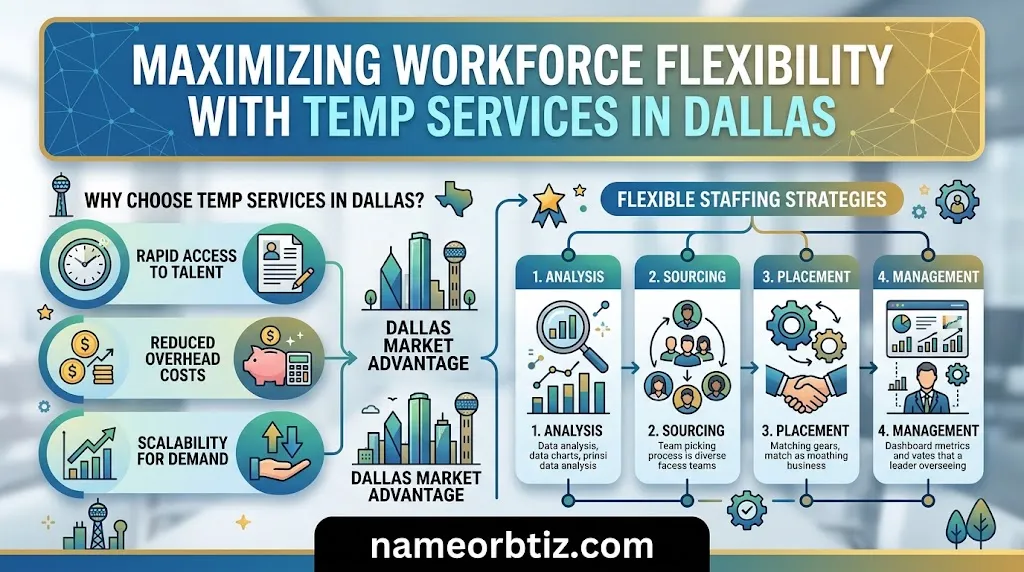
Practical Dallas Temp Staffing Decision Framework
Before requesting temporary workers, ask these questions:
Is the workload temporary or permanent?
If demand is consistently increasing, permanent hiring may ultimately be more appropriate.
How quickly must the position be filled?
Urgency can influence the best staffing model.
What skills are required?
Specialized needs may favor contract or project staffing.
How long will the worker be needed?
A short assignment and a long-term requirement should not be treated identically.
What happens if demand falls?
If staffing needs are uncertain, flexibility becomes more valuable.
How will performance be measured?
Define success before the worker starts.
Who handles employment administration?
Clarify payroll, benefits, safety, compliance, supervision, and reporting responsibilities.
“The best temporary staffing decision begins by defining the business problem before defining the job opening.”
Frequently Asked Questions
What are temp services in Dallas?
Temp services connect Dallas-area businesses with workers for short-term, seasonal, project-based, or otherwise defined workforce needs.
How can temporary staffing improve workforce flexibility?
Temporary staffing allows businesses to add workforce capacity when demand increases without automatically making every additional position permanent.
Is temporary staffing cheaper than hiring permanent employees?
Not necessarily. A temporary staffing bill rate may be higher than an employee’s wage, but businesses should compare the complete cost of recruiting, benefits, administration, insurance, onboarding, and the duration of the workforce need.
When should a Dallas company use temp-to-hire staffing?
Temp-to-hire can be useful when an employer wants to evaluate a worker’s performance and organizational fit before making a permanent offer.
What industries use temporary staffing?
Temporary staffing can support many sectors, including administration, accounting, customer service, logistics, manufacturing, healthcare, technology, construction, retail, and professional services.
How long do temporary assignments last?
There is no universal assignment length. Some assignments may last days or weeks, while others continue for several months or longer.
Are temporary workers protected by workplace safety laws?
Yes. Temporary workers are entitled to applicable workplace safety protections, and staffing agencies and host employers can share safety responsibilities.
Can a temporary employee become permanent?
Yes. Temp-to-hire arrangements can allow temporary employees to transition into permanent positions when both the employer and worker decide that the long-term relationship is appropriate.
Final Takeaway
Maximizing workforce flexibility with temp services in Dallas isn’t about replacing permanent employees with temporary workers. It’s about creating more workforce choices.
Temporary staffing can help businesses respond to seasonal demand, employee absences, projects, specialized skills, hiring delays, and uncertain growth.
The strongest strategy combines workforce forecasting, the right staffing model, efficient onboarding, clear performance expectations, responsible safety practices, measurable KPIs, and regular review.
For Dallas businesses, the real advantage isn’t simply access to temporary workers.
It is the ability to scale the right workforce at the right time while keeping long-term hiring decisions intentional.
Maximizing Workforce Flexibility With Temp Services in Dallas
Workforce needs rarely stay constant. A Dallas business may suddenly face higher orders, a major project, employee absences, seasonal demand, or an urgent skills gap.
That is where temp services in Dallas can provide more than quick hiring. They can give businesses another way to adjust workforce capacity without automatically adding permanent Headcount.
“Workforce flexibility isn’t about hiring more people; it’s about having more options when demand changes.”
What Workforce Flexibility Really Means
Workforce flexibility is the ability to adjust staffing capacity as business requirements change. It may involve temporary employees, contract professionals, temp-to-hire workers, interim specialists, or permanent employees.
A flexible workforce gives businesses multiple ways to respond instead of forcing every staffing need into a permanent-hiring model.
- “Flexibility means matching workforce capacity to business demand.”
- “Not every workforce problem deserves a permanent hiring solution.”
- “The smartest workforce is not always the largest workforce.”
- “Workforce flexibility begins with knowing which work is predictable and which work fluctuates.”
- “Temporary staffing creates options between doing nothing and hiring permanently.”
- “A flexible workforce gives management room to make better long-term decisions.”
- “The right staffing model starts with the business problem, not the job title.”
- “Flexibility is valuable when demand is difficult to predict.”
- “A workforce strategy should be designed around work, not simply workers.”
- “Permanent employees build continuity; flexible staffing can add capacity.”
- “The goal isn’t temporary hiring. The goal is adaptable workforce planning.”
- “A staffing model should change when the business requirement changes.”
- “Workforce flexibility turns uncertainty into a manageable planning variable.”
- “The best staffing strategy gives a company choices before it needs them.”
- “A flexible workforce can help businesses respond without rushing permanent decisions.”
Why Dallas Businesses May Need Flexible Staffing
Dallas-Fort Worth has a large and diverse employment market spanning industries with very different staffing requirements. Logistics, manufacturing, construction, professional services, retail, technology, healthcare, and other sectors can all experience changing workforce demands.
That diversity makes flexible staffing useful when businesses need additional capacity without knowing exactly how long the requirement will last.
- “Dallas businesses don’t all experience demand in the same way.”
- “A diverse economy creates diverse workforce requirements.”
- “Seasonal demand can make permanent headcount difficult to forecast.”
- “A sudden project can create a sudden need for specialized talent.”
- “Employee absences can create operational problems even when the business is fully staffed.”
- “Growth creates hiring questions before it creates hiring certainty.”
- “Flexible staffing can create breathing room during periods of uncertainty.”
- “The right temporary worker can protect productivity when internal capacity is stretched.”
- “Dallas businesses need workforce strategies that can move at the speed of demand.”
- “Hiring pressure doesn’t always mean permanent hiring is the answer.”
- “Temporary staffing can bridge the gap between today’s workload and tomorrow’s workforce plan.”
- “Business growth and workforce growth do not always happen on the same timetable.”
- “Flexibility matters most when tomorrow’s staffing requirement is unclear.”
- “A changing workload requires a workforce strategy that can change with it.”
- “The best workforce plan leaves room for changing business conditions.”
Temporary Staffing vs. Permanent Hiring
Temporary staffing and permanent hiring solve different problems. Permanent employees are often best suited to long-term roles, while temporary workers can provide additional capacity when demand is seasonal, project-based, uncertain, or short-term.
| Factor | Temporary Staffing | Permanent Hiring |
| Assignment | Defined or variable | Indefinite |
| Best fit | Short-term or changing demand | Long-term needs |
| Flexibility | High | Lower |
| Speed | Often faster | Usually slower |
| Long-term continuity | Limited unless converted | Strong |
| Seasonal demand | Strong fit | Often less suitable |
| Project work | Often useful | Useful when ongoing |
| Commitment | Lower | Higher |
- “Temporary staffing and permanent hiring are different tools.”
- “A temporary need should not automatically create permanent headcount.”
- “Permanent hiring makes sense when the work is expected to stay.”
- “Temporary staffing makes sense when the future is still being evaluated.”
- “The cheapest hiring decision isn’t always the most flexible decision.”
- “Hiring should reflect the expected life of the work.”
- “A permanent role deserves a permanent workforce strategy.”
- “A temporary workload deserves a solution that can end when the workload ends.”
- “The right staffing model depends on duration as much as urgency.”
- “Speed is valuable, but fit is what makes staffing sustainable.”
- “Temporary staffing can buy time for better permanent hiring decisions.”
- “Permanent employees provide continuity; temporary workers can provide elasticity.”
- “Workforce decisions become easier when duration is clear.”
- “Don’t turn a short-term problem into a long-term commitment.”
- “The best hiring model is the one that matches the actual business need.”
When Dallas Companies Should Consider Temp Services
Not every vacancy requires temporary staffing. Temp services become particularly useful when a company can identify a short-term workforce problem with a clear reason for additional capacity.
Common situations include seasonal demand, employee absences, special projects, sudden growth, hiring delays, and workforce transitions.
- “Use temporary staffing when the workload has a reason to end.”
- “Seasonal demand is one of the clearest cases for workforce flexibility.”
- “An extended absence shouldn’t automatically become an operational crisis.”
- “Projects often need skills without needing permanent positions.”
- “Hiring delays can create temporary workforce problems.”
- “Sudden growth creates a staffing question before it creates a staffing answer.”
- “Temporary staffing can protect deadlines during recruitment.”
- “An uncertain future makes flexibility more valuable.”
- “A temporary skills gap does not always justify permanent hiring.”
- “The best time to identify staffing triggers is before the crisis.”
- “Use flexible staffing when the business need is real, but the duration is uncertain.”
- “A short-term staffing problem deserves a proportionate solution.”
- “Temporary workers can provide capacity while management studies the next move.”
- “Workforce transitions often require continuity before they require permanence.”
- “Temp staffing works best when the business can clearly explain why the worker is needed.”

How Temp Services Improve Workforce Scalability
Scalability means being able to increase or decrease workforce capacity without rebuilding the entire organization every time demand changes.
Temporary staffing can give businesses additional capacity while leadership determines whether increased demand is temporary or likely to continue.
- “Scalability means adding capacity without automatically adding permanent complexity.”
- “A flexible workforce can expand when demand rises.”
- “The best staffing strategy leaves room for demand to fall.”
- “Workforce scalability is about capacity, not headcount alone.”
- “Temporary staffing can act as a bridge between demand and permanent hiring.”
- “A temporary increase in workload does not necessarily require permanent staff.”
- “Scalable staffing gives managers more room to respond.”
- “Demand forecasting becomes easier when workforce options are available.”
- “The ability to scale down can be just as valuable as the ability to scale up.”
- “Workforce flexibility turns staffing from a fixed decision into a responsive system.”
- “More workers aren’t always the answer; the right capacity at the right time is.”
- “A scalable workforce follows demand instead of fighting it.”
- “Flexible staffing can reduce pressure to make rushed permanent hiring decisions.”
- “Capacity should expand because the work requires it.”
- “The goal is not maximum staffing; it is appropriate staffing.”
Understanding the Real Cost of Temporary Staffing
A common mistake is comparing a temporary worker’s bill rate directly with a permanent employee’s hourly wage.
Permanent employees can involve recruiting, sourcing, interviews, payroll administration, benefits, employer taxes, workers’ compensation, training, onboarding, HR administration, and other costs.
The better comparison is the total cost of obtaining the Workforce capacity needed for the required period.
- “Hourly rate is only one piece of workforce cost.”
- “The lowest bill rate isn’t automatically the lowest total cost.”
- “Staffing decisions should measure productive capacity, not just payroll rates.”
- “A permanent employee has costs beyond the advertised wage.”
- “Temporary staffing should be evaluated through total workforce economics.”
- “Administrative simplicity has value, even when it doesn’t appear on a wage line.”
- “Cost comparisons become useful when they compare the whole employment model.”
- “A higher hourly rate can still be rational when the workforce requirement is short-lived.”
- “The right question is what the business pays for the required capacity.”
- “Recruiting time has a cost.”
- “Vacant positions have a cost.”
- “Slow hiring can become an operational expense.”
- “Workforce cost should include the consequences of being understaffed.”
- “Temporary staffing isn’t automatically cheap; it is potentially flexible.”
- “Good staffing decisions compare value, duration, risk, and total cost together.”
How Temp-to-Hire Can Reduce Hiring Uncertainty
Permanent recruitment involves uncertainty. A candidate may interview well but perform differently after joining the organization.
Temp-to-hire creates an opportunity for employers and workers to evaluate the working relationship before making a longer-term commitment.
- “A résumé shows potential; performance shows fit.”
- “Temp-to-hire can create evidence before a permanent decision.”
- “Hiring confidence improves when employers can evaluate actual work.”
- “Fit is easier to judge when people work together.”
- “A temporary assignment can become a practical evaluation period.”
- “Performance is more informative than interview promises.”
- “Temp-to-hire creates an opportunity for both sides to evaluate fit.”
- “The candidate isn’t the only one being evaluated; the employer is too.”
- “Good staffing decisions are based on evidence whenever possible.”
- “Temporary work can become a pathway to permanent employment.”
- “A trial period can reveal strengths that interviews cannot.”
- “Workplace compatibility is discovered through experience.”
- “Temp-to-hire can reduce uncertainty without forcing an immediate permanent commitment.”
- “The best long-term hires often begin with a clear understanding of expectations.”
- “A successful temporary assignment can answer whether the role should become permanent.”
Choosing Between Temp, Contract, Temp-to-Hire and Direct Hire
Different staffing models solve different workforce problems. Businesses should consider the duration of the need, required skills, urgency, budget, and expected future demand before selecting an employment model.
| Business Need | Model to Consider |
| Short-term workload spike | Temporary staffing |
| Seasonal demand | Temporary staffing |
| Defined project | Contract staffing |
| Specialized short-term skill | Contract or project staffing |
| Candidate evaluation | Temp-to-hire |
| Long-term core position | Direct hire |
| Temporary leadership gap | Interim staffing |
- “Choose the employment model before choosing the worker.”
- “Temporary, contract, and permanent hiring solve different problems.”
- “A project has different staffing needs from an ongoing department.”
- “Temp-to-hire is about evaluation as much as flexibility.”
- “Direct hire makes sense when the need is genuinely long-term.”
- “Interim staffing can protect continuity during leadership gaps.”
- “Specialized projects may need specialized staffing models.”
- “The duration of the work should influence the staffing commitment.”
- “Urgency matters, but it should not erase strategic thinking.”
- “A staffing model should reflect the expected future of the role.”
- “Don’t use temporary staffing simply because it is available.”
- “Match the employment structure to the business requirement.”
- “The right staffing model balances speed, skills, duration, and risk.”
- “A good staffing decision begins with clarity about what happens next.”
- “Different workforce problems deserve different workforce solutions.”
Building a Flexible Workforce Plan Before the Crisis
A flexible staffing strategy should begin before an urgent hiring crisis occurs.
Businesses can examine historical workload, seasonal demand, project schedules, employee turnover, predictable absences, and recurring hiring pressure to identify when additional workforce capacity may be needed.
- “The best staffing emergency is the one you planned for early.”
- “Workforce flexibility begins with workforce forecasting.”
- “Know your staffing triggers before you need them.”
- “Historical workload can reveal future staffing patterns.”
- “Separate permanent work from variable work.”
- “A staffing trigger turns uncertainty into an actionable plan.”
- “Prepared job profiles can accelerate future hiring.”
- “Workforce planning should happen before workforce pressure peaks.”
- “Define success before bringing workers onboard.”
- “A flexible staffing plan should include an exit strategy.”
- “Every temporary assignment should have a reason, objective, and review point.”
- “Good workforce planning reduces rushed hiring.”
- “Staffing flexibility works better when the process is already defined.”
- “Plan for both workforce increases and workforce reductions.”
- “The goal of workforce planning is fewer surprises, not more spreadsheets.”
Onboarding Temporary Employees for Productivity
Flexibility does not eliminate the need for onboarding. Temporary workers often need efficient, focused onboarding because their assignments may be relatively short.
They should understand their responsibilities, schedule, supervisor, workplace rules, technology access, communication procedures, performance expectations, and safety requirements.
- “Short assignments still deserve clear onboarding.”
- “Fast onboarding should mean focused onboarding, not incomplete onboarding.”
- “Temporary workers need to know what success looks like.”
- “Safety training should never be shortened because an assignment is short.”
- “The first day sets the tone for the entire assignment.”
- “Clear expectations reduce avoidable confusion.”
- “Every temporary worker should know who to ask for help.”
- “Efficient onboarding turns available labor into productive labor.”
- “A worker cannot perform well without knowing the rules.”
- “Good onboarding protects productivity and safety at the same time.”
- “The shorter the assignment, the more important essential information becomes.”
- “Temporary status does not reduce the need for workplace respect.”
- “Technology access should be ready when the worker arrives.”
- “Safety responsibilities should be clear before work begins.”
- “The goal is not less onboarding; it is smarter onboarding.”
Managing Quality, Productivity and Performance
Adding temporary employees does not automatically improve productivity. Managers should establish measurable expectations and track outcomes that show whether the staffing arrangement is solving the original business problem.
Useful measures include productivity, attendance, quality, safety performance, assignment completion, time-to-productivity, conversion rates, and cost per productive hour.
- “Labor hours are not the same thing as productive hours.”
- “More workers do not automatically mean more output.”
- “Temporary staffing should solve a measurable business problem.”
- “Performance expectations should be clear from day one.”
- “What gets measured can reveal whether staffing is actually working.”
- “Attendance is a workforce KPI, not merely an administrative detail.”
- “Quality matters as much as staffing speed.”
- “Time-to-productivity can reveal onboarding problems.”
- “Cost per productive hour is more useful than hourly cost alone.”
- “Managers should measure outcomes, not just headcount.”
- “Temporary workers need feedback just like permanent employees.”
- “A staffing program should improve business performance, not merely fill schedules.”
- “A fast placement with poor performance is not a successful placement.”
- “The real test of staffing is whether the business problem improves.”
- “Good staffing programs learn from their own performance data.”

Compliance, Safety and Employer Responsibilities
Using a staffing agency does not automatically eliminate workplace responsibilities. Staffing agencies and host employers may share responsibilities depending on the arrangement.
Businesses should clearly establish who handles payroll, supervision, workplace safety, training, timekeeping, incident reporting, workers’ compensation, and other employment responsibilities.
- “Temporary staffing does not mean temporary safety responsibilities.”
- “Every worker deserves a safe workplace.”
- “Safety responsibilities should be discussed before the assignment begins.”
- “The staffing agency and host employer need clear communication.”
- “A written agreement can clarify responsibilities.”
- “Workplace-specific hazards require workplace-specific training.”
- “Temporary workers should receive essential workplace safety protections.”
- “Compliance should be designed into staffing, not added afterward.”
- “A staffing arrangement should identify who handles each major responsibility.”
- “Confusion about responsibility can create avoidable risk.”
- “Speed should never come at the expense of worker safety.”
- “Safety belongs in the staffing conversation from the beginning.”
- “Temporary workers are part of the workplace, not visitors to it.”
- “Good staffing partnerships depend on communication as much as recruiting.”
- “Flexible workforce planning must include responsible workforce management.”
Common Mistakes Dallas Businesses Should Avoid
Temporary staffing can create flexibility, but only when implemented thoughtfully. Businesses can undermine the benefits by focusing exclusively on hourly rates, providing weak onboarding, using temporary workers for every vacancy, or failing to review assignments.
- “Don’t use temporary staffing simply because permanent hiring feels difficult.”
- “The hourly rate should never be the only decision factor.”
- “Poor communication can undermine a good staffing strategy.”
- “Temporary does not mean disposable.”
- “Weak onboarding can turn flexibility into inefficiency.”
- “A temporary worker still needs clear expectations.”
- “Treating temporary employees poorly can damage the entire staffing program.”
- “If a temporary role never ends, reassess the original strategy.”
- “Every staffing arrangement deserves periodic review.”
- “Fast hiring without proper management creates new problems.”
- “Don’t sacrifice quality for speed.”
- “Don’t sacrifice safety for convenience.”
- “Don’t sacrifice worker experience for flexibility.”
- “A staffing strategy should solve problems without creating bigger ones.”
- “The strongest flexible workforce programs balance speed, quality, cost, and respect.”
Measuring Whether Temp Staffing Is Actually Working
A successful temporary staffing program should be measurable. Businesses need to know whether placements are filling gaps, becoming productive, maintaining quality, and producing acceptable workforce value.
| KPI | What It Measures |
| Time to fill | Staffing responsiveness |
| Time to productivity | Onboarding effectiveness |
| Assignment completion | Placement effectiveness |
| Quality rate | Work standards |
| Attendance | Reliability |
| Conversion rate | Temp-to-permanent success |
| Cost per productive hour | Workforce efficiency |
| Manager satisfaction | Internal experience |
| Worker satisfaction | Candidate experience |
| Assignment turnover | Workforce stability |
- “A staffing strategy should be measurable.”
- “If you cannot measure the outcome, you may not know whether staffing is working.”
- “Time to fill measures speed; it doesn’t measure success alone.”
- “Time to productivity reveals what happens after hiring.”
- “Quality metrics protect against chasing speed at any cost.”
- “Worker satisfaction can influence assignment stability.”
- “Manager satisfaction can reveal whether placements meet expectations.”
- “Conversion rate can show where temporary hiring becomes permanent talent.”
- “Attendance can reveal workforce reliability.”
- “Cost per productive hour provides more context than bill rate alone.”
- “A staffing KPI should answer a business question.”
- “Metrics should lead to decisions, not simply dashboards.”
- “The best staffing programs improve through measurement.”
- “A placement is successful when it creates useful business capacity.”
- “Measure the workforce outcome, not just the hiring activity.”
The Future of Workforce Flexibility in Dallas
Workforce planning is moving beyond the simple choice between temporary and permanent employment.
A modern Dallas employer may use permanent employees for core responsibilities, contractors for specialized projects, temporary workers for demand spikes, and temp-to-hire arrangements for roles where long-term fit needs to be established.
- “The future of workforce planning is flexibility with purpose.”
- “One employment model cannot solve every workforce problem.”
- “Modern businesses need a portfolio of workforce options.”
- “Temporary staffing is one tool within a larger workforce strategy.”
- “The workforce of tomorrow will require both stability and adaptability.”
- “Businesses need to plan for changing demand, not pretend demand is fixed.”
- “Flexible staffing can create room for smarter permanent hiring.”
- “The strongest workforce strategies combine different staffing models.”
- “Technology may change hiring speed, but workforce judgment still matters.”
- “Flexibility becomes strategic when it is planned rather than improvised.”
- “The question is no longer simply, ‘ Who should we hire?”
- “The better question is when, where, how many, and for how long?”
- “Workforce choice can become a competitive advantage.”
- “Dallas businesses can benefit from staffing strategies built around changing demand.”
- “The future belongs to organizations that can adapt their workforce without losing sight of quality.”
Practical Dallas Temp Staffing Decision Framework
Before requesting temporary workers, ask these questions:
Is the workload temporary or permanent?
If demand is consistently increasing, permanent hiring may ultimately be more appropriate.
How quickly must the position be filled?
Urgency can influence the best staffing model.
What skills are required?
Specialized needs may favor contract or project staffing.
How long will the worker be needed?
A short assignment and a long-term requirement should not be treated identically.
What happens if demand falls?
If staffing needs are uncertain, flexibility becomes more valuable.
How will performance be measured?
Define success before the worker starts.
Who handles employment administration?
Clarify payroll, benefits, safety, compliance, supervision, and reporting responsibilities.
“The best temporary staffing decision begins by defining the business problem before defining the job opening.”
People also ask
A: Temp services connect Dallas-area businesses with workers for short-term, seasonal, project-based, or otherwise defined workforce needs.
A: Temporary staffing allows businesses to add workforce capacity when demand increases without automatically making every additional position permanent.
A: Not necessarily. A temporary staffing bill rate may be higher than an employee’s wage, but businesses should compare the complete cost of recruiting, benefits, administration, insurance, onboarding, and the duration of the workforce need.
A: Temp-to-hire can be useful when an employer wants to evaluate a worker’s performance and organizational fit before making a permanent offer.
A: Temporary staffing can support many sectors, including administration, accounting, customer service, logistics, manufacturing, healthcare, technology, construction, retail, and professional services.
Cocnlusion
Maximizing workforce flexibility with temp services in Dallas isn’t about replacing permanent employees with temporary workers. It’s about creating more workforce choices.
Temporary staffing can help businesses respond to seasonal demand, employee absences, projects, specialized skills, hiring delays, and uncertain growth.
The strongest strategy combines Workforce forecasting, the right staffing model, efficient onboarding, clear performance expectations, responsible safety practices, measurable KPIs, and regular review.
For Dallas businesses, the real advantage isn’t simply access to temporary workers.
It is the ability to scale the right workforce at the right time while keeping long-term hiring decisions intentional.